
Seminar: pesticides in cloud water – A. Bianco, P. Nibert
LAERO proposed a seminar on friday january 16th at 11AM in Salle Boussinesq (OMP Belin) by Angelica Bianco and Pauline Nibert from the Laboratoire de Météorologie Physique (LaMP, OPGC, U. Clermont Auvergne), present at OMP in the framework of a future collaboration with GET and LAERO for collecting cloud water at the Pic du Midi to analyse long-distance diffusion of pesticides.
1) Cloud chemical composition: pesticides in water droplets – Angelica Bianco
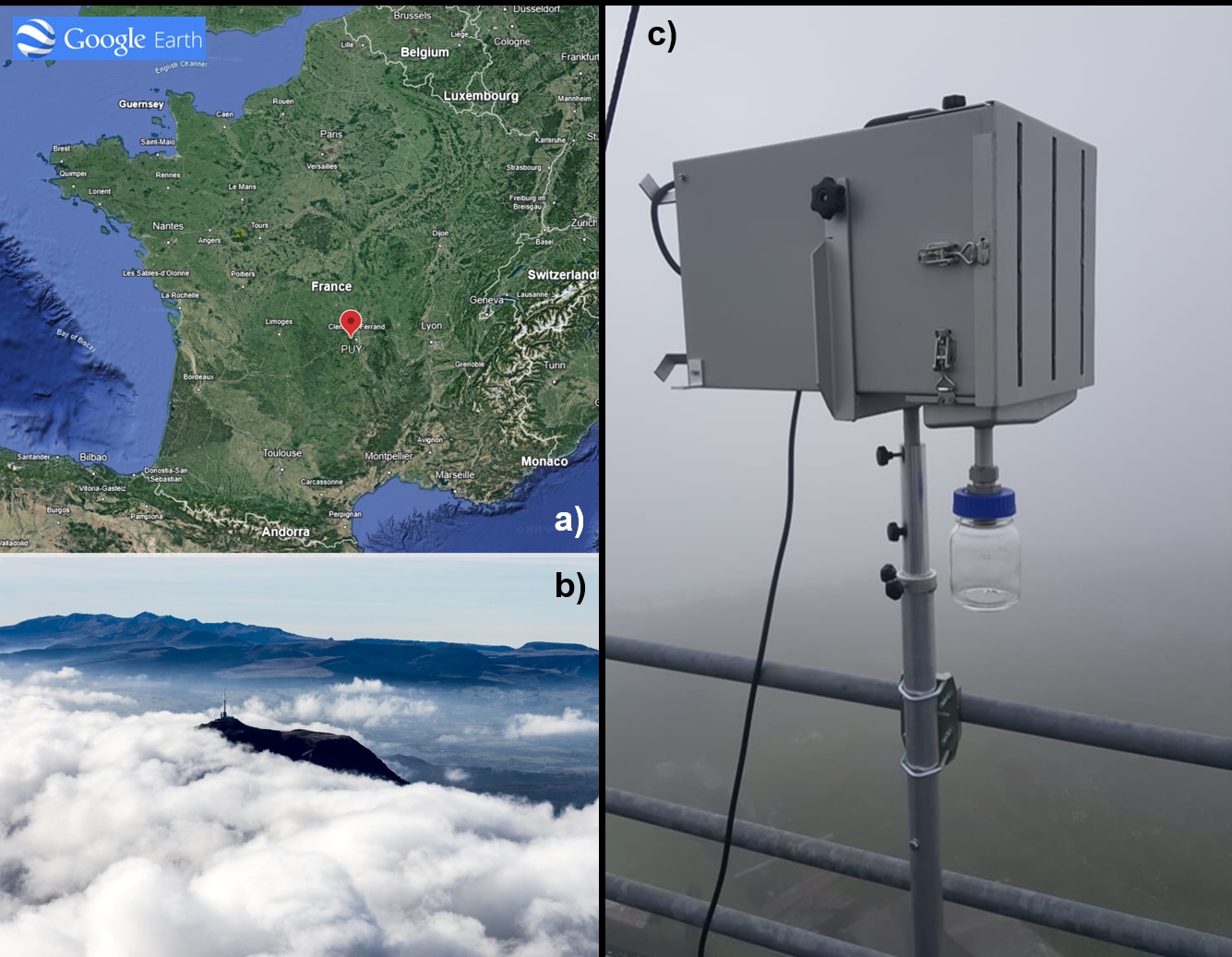
Since more than 20 years clouds have been sampled at the puy de Dôme observatory (France) using a collector specifically designed for high volume sampling. The physico-chemical analysis and the backtrajectory calculation enabled the classification of cloud water samples into four classes: highly marine, marine, continental and polluted. Target analysis were developed to quantify the concentration of short chain carboxylic acids, amino acids and, more recently, sugars. Pesticide contamination is a growing and alarming concern for both environment and human health. Widely used in agriculture to control pests and disease carriers, pesticides undergo extensive long-range atmospheric transport in the gas phase, aerosols and, as shown here, in clouds. We measured the concentration of 32 pesticides at the puy de Dôme observatory (France) in the sub-µg L-1 to µg L-1 range in cloud water, largely arising from regional to long-range transport that also involves pesticides currently banned for agricultural use in France. Half of the samples showed a total concentration of pesticides over 0.5 µg L‒1, which is the European drinking water limit. If 2,4-dinitrophenol, which can also be produced by photochemical reactions, is excluded, two samples still present a total concentration over 0.5 µg L‒1. The frequent detection of pesticides in rainwater may thus depend on their presence in clouds, as well as atmospheric washout. Estimates of pesticides quantity in clouds over France, ranging from 6.4 ± 3.2 to 139 ± 75 tons, suggest that their amounts in the cloud aqueous phase are potentially high and that these compounds would affect areas that are not directly impacted by agricultural activities.
2) High resolution mass spectrometry as a tool for unraveling cloud organic matter – Pauline Nibert
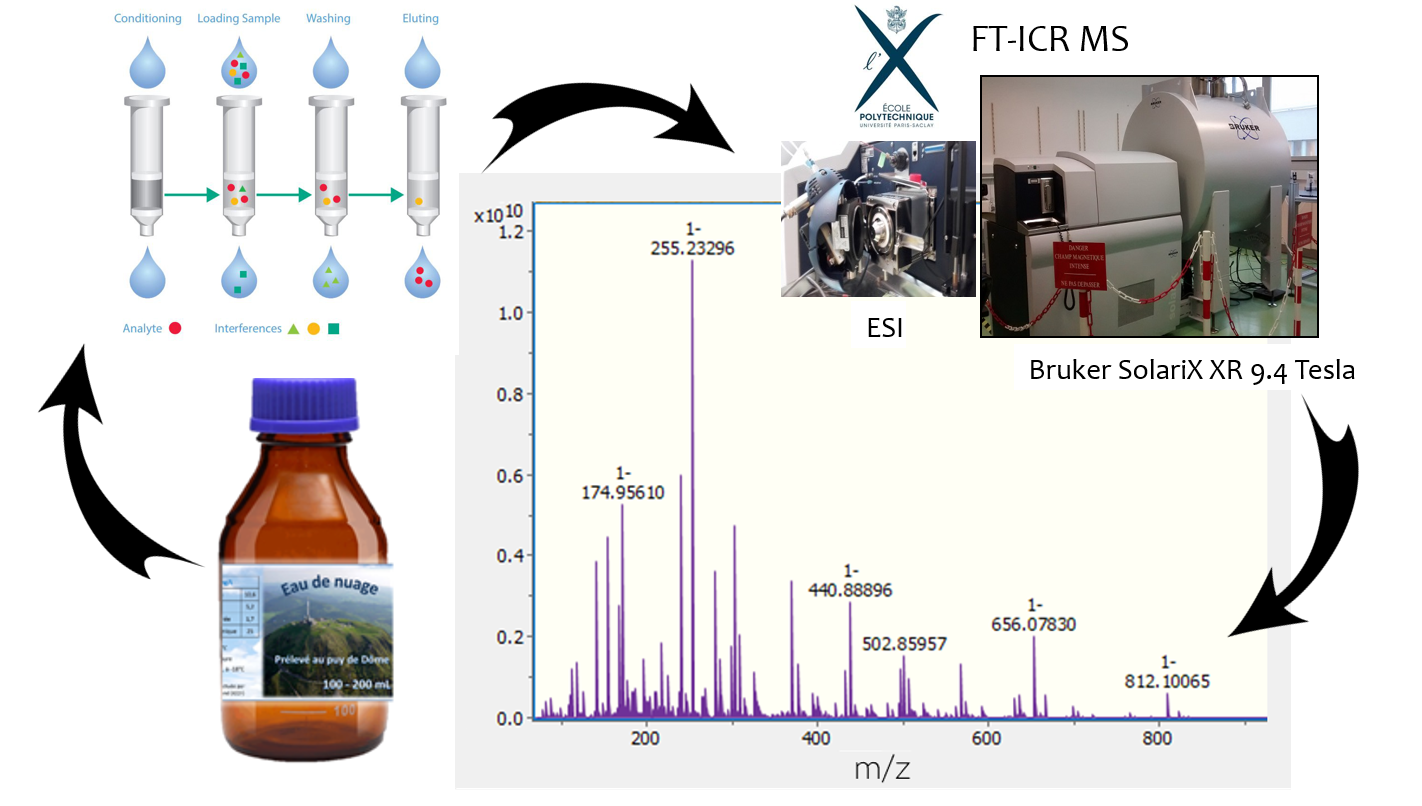
FT-ICR MS (Fourier Transform Ion Cyclotron Mass Spectrometry) is a powerful tool to investigate cloud water composition: in contrast to the methodology previously used for cloud water study, it provides a global overview of the dissolved organic matter. Combined with classification methodologies, such as the van Krevelen diagram or Rivas-Ubach classification, it may highlight which families of compounds are transformed. We present the characterization of the chemical composition of cloud samples collected at the Reunion Island (Indian Ocean), at Monte Cimone (Italy) and at puy de Dôme (France). Cloud water is first desalted and pre-concentrated by solid phase extraction and then analyzed by FT-ICR MS with electrospray ionization. Molecular formulas are assigned using MFAssignR software. Statistical tools are used to investigate the differences between samples collected at the three locations.
Do you want to know more?
- A. Bianco, P. Nibert, Y. Wu, J.-L. Baray, M. Brigante, G. Mailhot, L. Deguillaume, D. Vione, D. J. E. Cabanes, M. Méjean, and P. Besse-Hoggan, Are Clouds a Neglected Reservoir of Pesticides? Environmental Science & Technology 2025 59 (40), 21579-21588
- M. Vaïtilingom, C. Bernard, M. Ribeiro, C. Berthod, A. Bianco, L. Deguillaume, Design and evaluation of BOOGIE: a collector for the analysis of cloud composition and processes, Atmospheric Measurement Techniques, 18, 1073–1090, 2025.
- L. Pailler, L. Deguillaume, H. Lavanant, I. Schmitz, M. Hubert, E. Nicol, M. Ribeiro, J.-M. Pichon, M. Vaïtilingom, P. Dominutti, F. Burnet, P. Tulet, M. Leriche, A. Bianco, Molecular composition of clouds: a comparison between samples collected at tropical (Réunion Island, France) and mid-north (Puy de Dôme, France) latitudes, Atmospheric Chemistry and Physics, 24, 5567–5584, 2024.